For millennia, humanity has been guided by prophets and teachers who preached love, humility, and unity. Yet, the world remains divided by ego, power, and belief. This essay explores why, despite the wisdom of our religions, we continue to repeat the same moral and spiritual mistakes and what it means for our collective evolution.
Across the centuries, prophets, sages, and teachers have appeared to remind humankind of the same simple truths: love one another, live with compassion, and seek the divine within. Yet, despite the wisdom handed down through every religion, civilization continues to struggle with the same divisions: of race, creed, class, and power. The question is not whether we were taught the truth, but why we still fail to live it.
At the heart of this failure lies human attachment: to identity, tradition, and power. We cling to what feels familiar, even when it confines us. Religion, born as a bridge between humanity and the divine, often becomes a fortress of exclusion. Traditions meant to preserve meaning turn into cages that protect comfort and resist change. Over time, the message of unity transforms into the machinery of hierarchy, and the symbols of truth become tools of control.
This paradox is not divine in origin; it is human. The same instinct that once kept our ancestors safe in tribes now fuels our spiritual narrowness. We fear what is different, mistaking difference for danger. We build walls of belief around ourselves and call them sacred, not realizing that truth was never meant to be owned, only discovered.
The great reformers of history all sought to break these walls. Each called humanity to return to essence: humility over pride, understanding over dogma, compassion over control. Yet, the cycle repeats, for institutions have a life of their own, and the ego finds new ways to survive, even in the language of holiness.
Perhaps the deeper lesson is that humanity is still growing; intellectually advanced but spiritually young. We know how to build empires, but not how to build understanding. We master the language of God, but not the silence where God speaks.
True religion, then, is not a set of traditions, but a movement toward awakening; a journey from the self that clings to the self that lets go. The day we see faith not as a boundary but as a bridge, humanity will have finally learned what it has been taught for millennia: that the divine was never divided; only our hearts were.
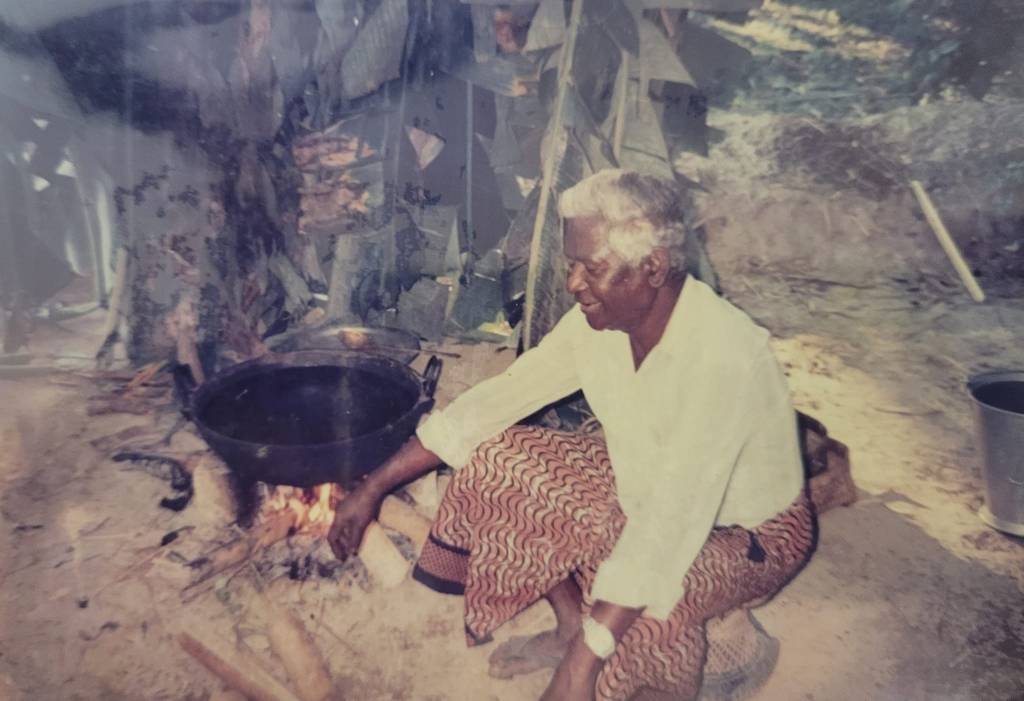
I don’t have a close relationship with my grandmothers as is found in many Indian households. My paternal grandmother spoke mostly Sadri and was shy to speak in Hindi even if she knew it. We didn’t speak much as I mostly spoke Assamese with my uncles and aunts. However, she is a hard-working yet calm lady. She used to cook meals with organically grown food in the semi-urban area that they were at. Whenever my uncles visited Guwahati from Dhekiajuli (Sonitpur), I would request them to bring some rice rotis prepared by my grandma. My dad had a transferable job. As long as he was in service, it was difficult moving about dogs. So we kept our dogs at our grandmother’s place. She was incredibly affectionate towards them.
My materal grandmother was a nurse who worked till superannuation. When my sister and I were little children, she used to get us candies and give us some money before leaving, back to Hatiali (Chabua) from Guwahati. Unlike my paternal grandmother, there were no language barriers with my maternal grandmother. Even then, we spoke less and only to the extent that was required.
What we have between our souls is like no other; No I don’t need to find another when I’ve found her. Even in our silences, the greatest stories are told As new pages in the story of life we unfold.
Badgered seems my words when we try to get close. Pardon me, but I’ve missed you too long. I bleed without bloodshed, I weep without tears; My heart is pierced without a spear.
I say that my red hearts are only for you As I would bleed my last drop to protect you; You, my love.
Forgive me dear beloved, I am a little old fashioned. I like suits rather than tattered jeans, I want to express my love for you in person Rather than a virtual language of ones and zeros. This distance, this time, this sacred geometry This excruciating worry
Is something I pray syncs to make us meet soon Like nature – imperfect and unequal, But always in equilibrium.
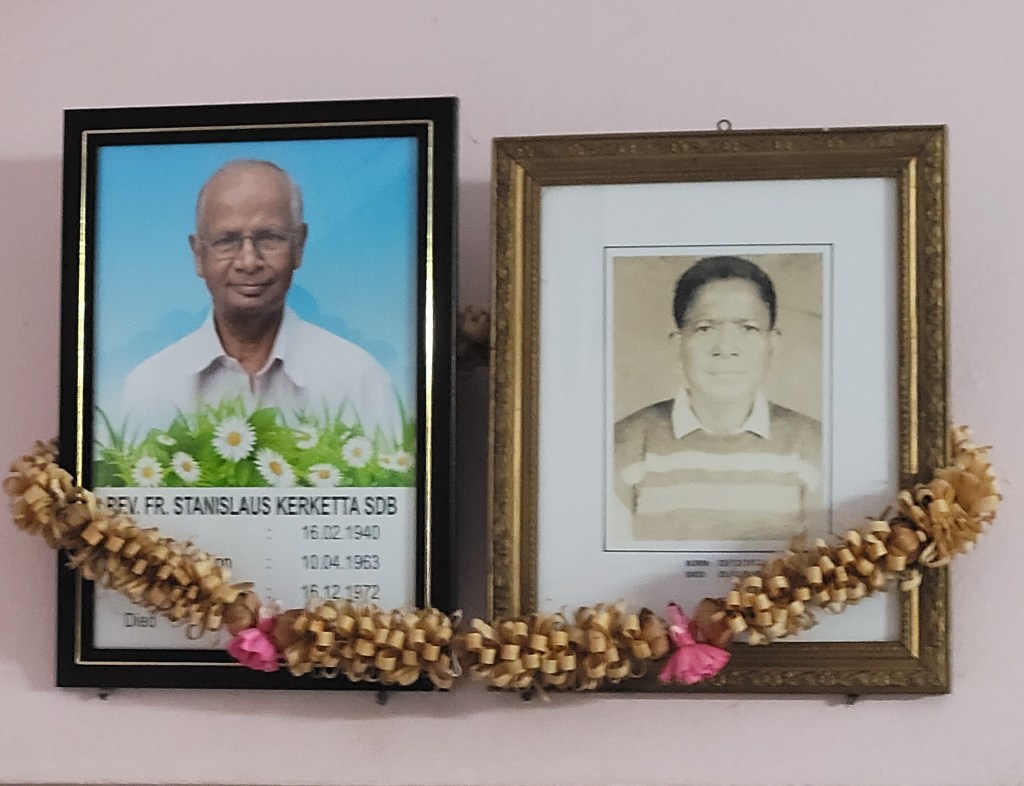
Late Reverend Father Stanislaus Kerketta, sdb (Left; My paternal granduncle),
Late Louis Kerketta (Right; My paternal grandfather)
Trigger warning: death, stroke
I only have faint memories of my paternal grandfather. He passed away when I was a little boy. I remember sitting down together in an evening around a bonfire. Although I do not have more memories of my grandpa (Nana, as I would call him; instead of Dadaji, the accurate Hindi term), I came to know a lot about him through my dad, uncles and aunts. My ‘nana’ was a Hindi teacher at a school, not far away from their house. Apparently he was quite popular as he was respected and loved as a teacher. When I studied the Hindi language in school, I would often refer to a Hindi dictionary that he left behind. It was quite useful and helped me a great deal.
My nana apparently was a kind and loving person. He was quite social. Although he had been a Sarna dharma (Nature worship religion) priest, he was a practicing and faithful Roman Catholic after wilful conversion. My grandma, and relatives after them continue to be practicing faithful. Nana’s untimely death was a bit of a mystery. He had gone to the loo post midnight and was found passed away later with his watch stopped at 2:30 am. My dad preserved the watch in my nana’s memory.
There’s this funny thing my dad told me as a child, to console me whenever there was a thunderstorm and I would get a bit scared, “Tumar nana’e football khelise,” which translated from Assamese into “Your grandfather is playing football.” That would work like a charm in calming me down.
My paternal granduncle, whom I called ‘Father nana’ lived a ‘full’ life. I called him so because he was a Catholic priest. Father nana, or just nana, was a simple, yet hard-working person. He was quite dedicated to his priestly life and also loved my sister and me dearly. He filled any void my sister and I might have otherwise had after the loss of our grandfather. He would get chocolates for us. I remember asking him for a Five-rupee tasty digestive treat once, while going on an evening stroll together. Although he was a Salesian priest and swore an oath of poverty, he did not hesitate to buy one for me. It was only much later that I came to know of the Salesian oaths made at the time of a Catholic priest’s ordination. Nana would be keen on overseeing the vegetation that grew on the Salesian establishments he was posted in, look after the seminarian boys, go to many rural areas to celebrate Mass among other things.
I remember the time when he was posted in Tinsukia. My sister and I would go visit him during summer vacations. He would crack many jokes. Nana had false teeth that he would remove and show us, which amused us a lot. He would let us type letters or simply write on his mechanical typewriter now and then. I would also read a few publications of the Salesians of Don Bosco during the vacations.
Father Nana’s immediate family lived in Jamuguri. Towards the end of his service, he was at Don Bosco Salesian house, Dibrugarh. He would visit us from time to time. We would go visit him too. He was healthy for the greater part of his life. Having a stroke during the last days of his life might have been upsetting as he was otherwise quite an active person, despite being a diabetic. The priests and brothers at the Salesian house took care of him. We also went to visit him; sometimes just mom and dad, sometimes me as well. I could see it in his eyes that he felt helpless. He found it difficult to speak because he was partially paralysed after the stroke. But I could also tell that he was satisfied that we had gone to visit him. He wanted to visit his family in Jamuguri, but the place was far away. He was not in a condition to travel and the Covid-19 pandemic still posed a threat. Later, nana contracted coronavirus and laid to rest in May 2021.
The love and life of both my grandfather and granduncle was something that many hold closely, both family and others, whose lives they touched. Thank you, dear nana’s.
With honor and gratitude, I am pleased to share memories of the 5 glorious years I had spent at St. Joseph’s University (Bengaluru) and how it shaped me through education, outreach, and values to set and achieve high goals, as the Jesuit philosophy goes, “magis” or “the more.”
It was in 2012 that I joined St. Joseph’s University (then St. Joseph’s Autonomous College), in the Humanities section for BA Economics, Political Science and Sociology. Each semester at Joseph’s helped me grow as a student and as a person. SJU has always had students from all parts of the country and even other countries who actively participated in all academic, sports as well as cultural events. This provided an inclusive environment and a space to know and understand the situations, cultures and perceptions of students and the conditions of their home state or country. SJU also had specially-abled students and I have had conversations with quite a few of them.
The professors at SJU have always been quite approachable and always ready to help students, not only in their academic progress but also in personal development. I’m glad to have had the guidance and mentoring of all the professors of humanities, even if I wasn’t in their class. I am glad that I was continuously mentored by Prof Clement D’Souza and Prof Jerome Nirmalraj who have shaped my moral and work ethics to a great extent. I am glad to have studied Sociology through classes by Prof Berin Lukas. Although I History was not a subject in my BA course, it was always a pleasure talking to Fr Clarence D’Souza who was also the Administrator back then. Prof Latha Radhakrishnan was another Professor I will remember for the clarity of her lectures. Prof Somaiah’s helped clarify political concepts and public administrative structures well. Prof Anuplal was also quite supportive even though I didn’t have Industrial Relations as a subject.
I was also quite fond of the English Department as I have a close connection to books and literature, although my professional interests have always leaned towards Economics. I truly enjoyed classes by Prof Etienne, Prof Jyotsna, Prof Namrata, and the conversations with Late Prof Padma. There were many other Professors in other departments like Prof Kiran Jeevan in Social Work, Prof Johnson Rajkumar and Renee D’Souza, Melvin Colaco, Prof Bojamma, Prof Beatrice Siqueira and others with whom I had the pleasure to talk to and even learn from.
I was a part of both academic and cultural associations at SJU. As Vice President of Social Zest, it was great to work with Prof Anita Noronha and Prof Maria David. I was also closely involved in the Political Science Association as a core committee member, under the guidance of Prof Jerome. I also had the pleasure of editing ‘Echoes,’ the annual publication by NETSF. I was also a part of the college choir and I made many friends from the Science section of SJU through the choir. I was a part of both CSA and AICUF, but for limited time. Apart from associations, I was also a student member of IQAC and a student editor of the College Yearbook. SJU’s fests were
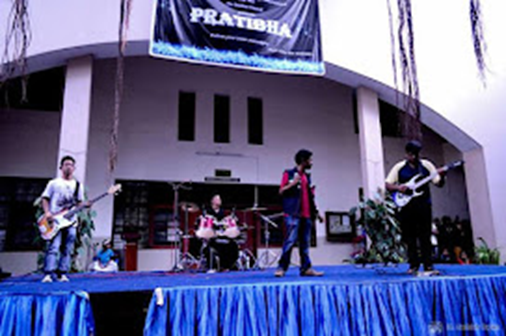
always something to look forward to, like Visages, Exodus, and Footprints. It was a time to participate, perform, enjoy, compete, make friends, appreciate, and learn. The fests also gave me enough occasions to click photographs and it helped me improve my photography skills. As I was also a musician, I had many opportunities to perform in various events in college. Sports Day was fun too. I used to sketch portraits and one room in the Humanities Block was reserved for an art exhibition on Sports days. So, I had put up my sketches there.
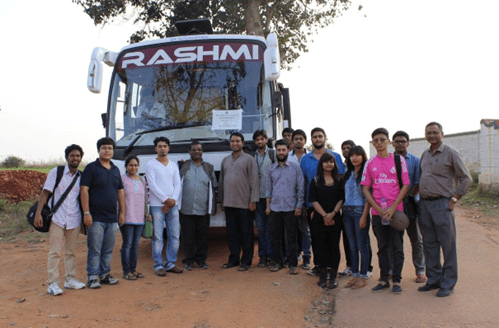
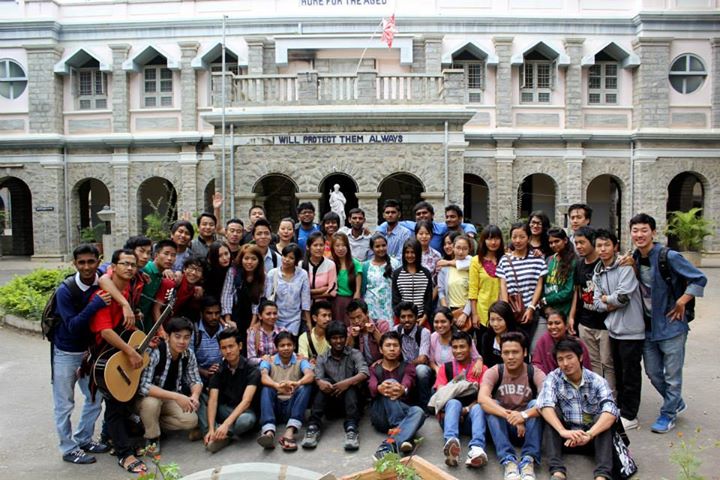
The college (now University) also offered several opportunities to travel to different places in Karnataka for personal development as well as social outreach. I had gone to Mangalore through SJU to attend a ‘Soft Skills for Employability’ workshop and to Mysore to attend a Leadership camp. The venue for AICUF’s State meet was also in Mangalore back then and I had got an opportunity to be a part of it though the association. Our class had also gone to Yercaud in Tamil Nadu for a Sociology study trip related to social research and Raichur district for Bembala outreach. The Political Science Association, Spectrum, had arranged a visit to Navadarshanam, an Eco farm. The Economics forum had arranged a trip to Chennapatna toy factory and Heritage Winery, which I was a part of. SJC also offered many certificate courses. I had signed up for Legal Literacy and it has proved to be useful even today.
I ‘crossed the street’ to continue my education at St. Joseph’s University in MA Economics. Although it was an intense course, as students we had moments to have our share of fun and relaxation amidst our studies and academic discussions. I am truly grateful to the PG faculty during my days there, including Prof Subhashini, Prof Manojit, Prof Anirban, and others. I also had close friends in the Mass Communication and English Departments and talking to them was a good break from the regular lectures. Sometimes learning something different as a hobby is relaxing. So, when I spoke to friends from other departments, I did learn a thing or two from them about their area of expertise and that was not only helpful but a healthy diversion from the intensity of lectures. I also participated in an idea pitching competition at the Changemaker Week 2016 event organised by Ashoka India, a network of social entrepreneurs, bagging the First Prize.
While pursuing my master’s degree, I got an opportunity to intern at NIAS and then another opportunity to intern at IGIDR. I chose the latter eventually, which helped me in a great way. I gained practical experience to work with large datasets not only during the internship, but also while preparing my dissertation. After graduating from St Joseph’s College, this time for MA Economics, studied Data Science from International Institute of Information Technology in Bangalore via upGrad and started working as a data science consultant at Quantzig. The very next year, the COVID-19 pandemic had its first wave. I quit and went back to my home town, taking a break from my regular career and instead learning, teaching economics to school students and taking guitar lessons for children.
Soon the danger levels of the pandemic started to decrease and companies started to hire again. I applied and got into PricewaterhouseCoopers India as a Senior Analyst. I was in the Economics and Public Policy team of the Economic Advisory Services competency. I am grateful to St. Joseph’s College (now a University) for imbibing in me the values, ethics and giving me ample opportunities to learn and teaching me to always keep learning. The virtues of ‘faith and toil’ continue to guide me in my work as move from one ambition to the next.
Over the years, I have realised that one can learn a lot even from a grain of sand. There are a few realisations that I have penned down:
1. Conquer with love, not with authority. It’s good to be a survivor only if you have something to get back to.
2. Humility, dedication and passion is the passenger ticket to a rocket to your goals.
3. People fight for you, Against you Or over you. That is the price of popularity.
4. It takes great courage to defeat one’s own ego and remain human.
5. Take something that annoys you and learn something useful from it.
6. Do good. Be good. Get good.
7. Personalize your life.
8. Pay attention to detail, but do not let lost in it.
9. When you write a song, write the words your heart is shouting out to you for attention.
10. A Leader is a person who raises everyone with him/her as he/she rises.
11. Be a message, not a messenger.
12. Let’s learn from nature. Nothing’s perfect, but everything is in equilibrium.
13. Restrictions kill Creativity.
14. Failures don’t matter if you start moving your focus towards success.
15. Don’t do anything for the sake of doing it. Do it only if it’s relevant.
16. Be proud enough to have standards, humble enough to learn.
17. Save your seconds. (time)
18. Don’t belong to anything. Let things belong to you.
19. Meet the expectations you have from yourself and everything else will follow.
20. Live like a poor person. Think like a rich person. The mindset is what leads you to do great things.
21. Time is movement. Keep moving.
22. Nothing is big enough for arrogance. Nothing is small enough for gratitude.
23. We often do things that we wouldn’t normally do when we are at the peak of emotion – excited, enraged, sorrowed. Strangely, it is the things we do at these moments that make the most memorable differences in our lives.
25. The greatest enemy of anything good, to become great, is lack of patience.
26. If someone wrongs you, do not wrong them back. Move on and focus on your goals. Achieve such a pedestal in life that their wrong would become insignificant.
27. Never reveal your plans before they have been materialised.
28. Don’t chase money. Do what you love, put your heart and soul into it. Money will chase you.
29. As long as you are humble, you will always keep learning. Learning more will increase your ability to grow in all spheres.
30. Whoever thinks money is wealth is already poor.
31. The only things that are good or bad are intentions and outcomes. Whatever happens in between is irrelevant.
32. You don’t get gold on the earth surface. You gotta dig deep. If you judge a person too quickly, you not know what they are worth.
33. If you want to be friends with two people who are enemies, you will ultimately lose both.
34. There are only two realities where matter exists – Time and space. Everything else is either spiritual or fiction.
35. Fight against adversities, not adversaries.
36. We are all part of the same species, some of us are from the same bloodline and even maybe the same family. What unites or separates us is who we choose to be from within.
37. When others look up at you for inspiration, every breath becomes a resonsibility.
38. Telling people what they want to hear might make you popular, but won’t get you any real friends.
39. Then fate said, “I have no past. present or future. But all pas, present and future depends on me.
40. Is a career just something to fill our pockets? Can’t it be a seamless, flawless journey?
41. Presence in the present is more important than presents.
My grandfather was a good story teller. He would ask me to sit down and express the story as it proceeded and even animate it to a great extent. I was a merely a child when he told be the story of the Tower of Babel. I only realised it when I was old enough to started going for Catechism classes in school.
With his deep voice, he modulated the narration and use the Lego blocks I was playing with to help me capture the story into my memory.
The story of the Tower of Babel (Genesis 11:1-9) in the Bible is as we know it, a story of the people desiring to build a tower so high that they could reach heaven, with a common belief that the heavens are in the sky. The people brought stone bricks and bitumen mortar and got to work.
My grandfather kept joining the Lego blocks and built a towerlike structure as he spoke. He said,”Then the people wanted wanted to buid the tower high and higher. Finally when they thought that they had almost reached, they fired and arrow to the sky.”
The people who worked to build the tower spoke and understood the same language. Then my grandfather continued, “Then God confused them by making them understand and speak different languages.”
The tower of babel remained incomplete and the people’s arrogance shattered.
The tower was incomplete, but the world got its many languages to spread across the earth and live everywhere, creating civilizations, cultures and stories thoughout history.
There once lived a man in a village predominantly occupied by Adivasi communities in India. He was among the rare Adivasis who knew how to turn into a Lion, temporarily. However, there was a major flaw in this transformation. Once he transformed into a lion, he would lose all human consciousness. He would destroy everything in his way, often posing a danger to others. It was said that he had also injured others after transforming. One fine day, when he transformed, something happened that he couldn’t forgive himself for. Without any memory or consciousness, his family met an end by his own hands (claws). That was when he abandoned transforming into a lion forever. He was strong and superhuman but had lost his family. He thought to himself, “What good is a supernatural ability if I cannot protect my own?”
Calling spirits
Occasionally, when their wives were away – sitting together, chatting, and smoking a local-made hookah, the elder men of the village would gather in a circle and decide on calling spirits and talking to them. Calling spirits was not an easy task. What made it more difficult was that sometimes the spirits were unfriendly. There was also a chance of being possessed. So before calling the spirit, the elders would have a bit of alcohol so that they become impure. Spirits do not enter impure bodies, they say. Then they would light a fire and do the necessary rituals to call a spirit. They would talk to the spirit that they called and once the spirit left, the fire would go out. These events were not free from risks and mishaps and eventually people considered that it is a better to stop it altogether.
The great betrayal
Once there lived a pious and kind priest. He had a shikha (knot hair) and wore a sacred thread. It was afternoon and a few guests came over. They were priests too. They had a shikha as well, but no thread. Also, they were fairer in complexion compared to the host, although both were from the same land. Both the host and the guests sat down to eat. The host’s wife served them the best rice, lentils, vegetables, and fruits. She also offered them curd with some jaggery. After everyone had eaten to their full, the host’s wife collected the plates for cleaning. The host priest and the guests proceeded to wash their hands by the pond. Before washing his hands, the host said a prayer and removed his sacred thread. After they had all washed hands, the guests took the host’s thread. Before the host could do anything, they fled.
Since a couple of weeks, I had been getting suspicious posts from my friend’s social media account. I knew that her account had been hacked. The fraudster was using her identity and her account to convince people that she was winning lotteries and giveaway money and dupe their targets of money and also taking control of their social media handles. Today, the fraudster tried to make me their target.
They sent me the infamous “Guess the number and win” 40K photo. (Money giveaway fraud)
So I decided to play along. I guessed the number and asked the person on the other side to pay up. The fraudster congratulated me and said that I had won giveway money and asked me how I wanted to intiate the transfer. I told them that they could transfer via UPI. The fraudster ask me to do something first, which was quite expected. They asked me to change the email address associated with the social media account. For those who don’t know, doing this can give complete ownership of your social media account to the unethical hacker/fraudster. They asked me to do it and share a screenshot.
So, of course I didn’t do it. But, I did share a fake screenshot using simple free pre-installed tools on a computer/laptop. The conversation went like so, although the hacker deleted many of their messages once the conversation was over.
They had also provided me fake screenshot messages showing that people had received the money, which they deleted. It was time to end the conversation.
The hacker has committed identity theft and financial fraud and probably continues to do so. I knew they wouldn’t pay by regular channels because if they did, it would disclose information about the hacker. I confirmed with my friend over the phone if her account was really hacked over the phone and reported the account. Later, the hacker blocked me.
Anyone can be a victim of Cyberfraud, no matter the education. Even doctors and layers have been victims of cyberfraud. Here are a few things you can do to keep yourself and your friends safe:
Stay alert.
Change passwords regularly and keep them strong.
Read/Watch updates on cybersecurity from time to time, to know about the new methods the fraudsters use.
If it is an email, always check the email address.
Do not click on any suspicious links or pop-ups on emails or the web.
Always use Two-Factor aunthentication for your accounts.
Never share OTP or PIN numbers.
Help a friend out. Report accounts that are hacked and do so in large numbers with attachements/screenshots if you have any.
Reach out to the Support team of the social media app or website.
File a report to the Cybercrime Cell of your country.
I had been learning and playing the guitar since early 2005 at a comfortable age of 12. I’ve had three music instructors for guitar and music theory. I appeared for few guitar and music theory certifications as well, by Trinity Guild Hall (London) and joined an intermediate course much later by Nathaniel School of Music (Bangalore).
Although I picked up an instrument to learn at that age, I had been into singing earlier and even had an opportunity to get some basic vocal training in Hindustani Classical music. When I was in high school in 10th standard, I started writing songs and composed an instrumental track in 2009. I discussed it with a friend and we improved on it and another friend even added lyrics to it, but it never got materialised.
After my senior secondary (12th standard/PUC) exams, we got a 3-month break. I took decided to spend that time write lyrics and composing. I wrote several songs and wanted to make an album. But I also wanted to put my best songs forward and since the ‘project’ was independent and entirely self-funded (or let’s say parent funded), I decided to make an EP (Extended Play) rather than an LP (Long Play). An EP has 4-6 tracks as opposed to 12-13 tracks in LPs. It is based on track duration and its origin goes back to vinyl records.
I had made a musician friend in the city who was also a guitar, a brilliant one at that. One day, as we were chatting over ‘Messenger’ (Facebook, now Meta) and I told him about my project. Incidentally, he was planning to start a home studio and take up clients. So, we had a discussion at his place and decided to recorded five of my tracks.
Glad I got to be one of his first clients, I starting recording my compositions one by one. I used a software to convert music notations into audio and sent it to him to give him an idea of what I had in mind. We recorded the instruments. He suggested that he’d play and asked me to focus on the vocals. He played the guitar and piano sections of my compositions and added synth and other effects wherever required. The drums were programmed using a MIDI board. I sang for my first track ‘For Nothing.’ This song took the longest time to compose and is also the longest track in the EP, ‘Freedom of Emotions,’ but took only one take. Although we did record it multiple times for panning, variations, and other track requirements.
After the first track, I recorded a song dedicated to two of my close classmates who had accidental deaths. The next song was the title track, ‘Freedom of Emotions.’ I decided to work on this song with my friend, guitarist, and producer together. I had composed it with all the sections, melody, scale, chord progression and time signature and written the lyrics. He added variations in the guitar harmonics intro using layers and improved the strumming pattern and added a kickass guitar solo. The song had less lyrics and progressed quickly, so I gave him complete liberty with the section before the outro and the results were epic! Next, there was a track called ‘Break Free’ that his father really liked. Finally, we ended the EP with the only Hindi track in the EP, ‘Itni Sundar Tum Ho Kaise,’ which has the highest hits in the EP, followed by the title track. Like so, after mixing and mastering, in 2012 in the city of Guwahati, my music album was ready. The music in the tracks were played, mixed and mastered by Siddhant Das from Studio Dreamcather, Guwahati, which now stands closed.
Now as I was an 18-year-old with an independent music project in 2012, I didn’t want to go to any marketing agency. So, I decided to do it on my own, with absolutely no experience of marketing and promotions. Maybe taking up Commerce for 10+2 studies helped.
There were was no Spotify in India back then and online music distribution platforms weren’t quite active. I uploaded my tracks to platforms like SoundCloud and ReverbNation for streaming initially and shared the links to Facebook. I created and managed a Facebook Page and a YouTube Channel. I added my music to more platforms like MuSlate and SongDew. I also shared links to the songs and sometimes the tracks themselves with friends. I also availed the tracks for free downloads for a limited period. The responses were positive.
The album art that I used for ReverbNation was a simple a simple photograph from the balcony of an apartment flat that our family were living in as tenants in Uzan Bazar, Guwahati.
When I joined Undergrads that same year, I performed many times in college events and performed my tracks and newer compositions as well. During my PG studies, I was invited to take up independent sections of events for music. I also performed in open-mics in various locations in Bengaluru. I was also into photography. So, one evening when I was clicking photographs for a friend’s music gig, she asked me to perform 1 or 2 songs as well. The artist manager at the venue was really impressed by my performance and we got talking. He offered me a gig as well. But I unfortunately had to cancel it later, as I got busy with my dissertation at the University.
When Instagram launched and I started using an Android phone, instead of a Lumia phone, it was a great platform initially for sharing my photographs to it users Although Instagram has evolved to be a completely different platform today for creators, businesses, and all other users for various purposes. I also uploaded short video covers of popular songs on Instagram over time, performed some originals, used Instagram for promotions and even went live to perform.
I also wrote poems, articles and stories on WordPress. So I added a section to my music links there as well, for people to listen.
Much later, when Spotify was in India and other music streaming platforms like YouTube Music, Amazon Prime Music, JioSaavn were also getting popular, and I had some personal savings, I decided to distribute my music through online streaming platforms including Apple Music Store using cdBaby in 2020.
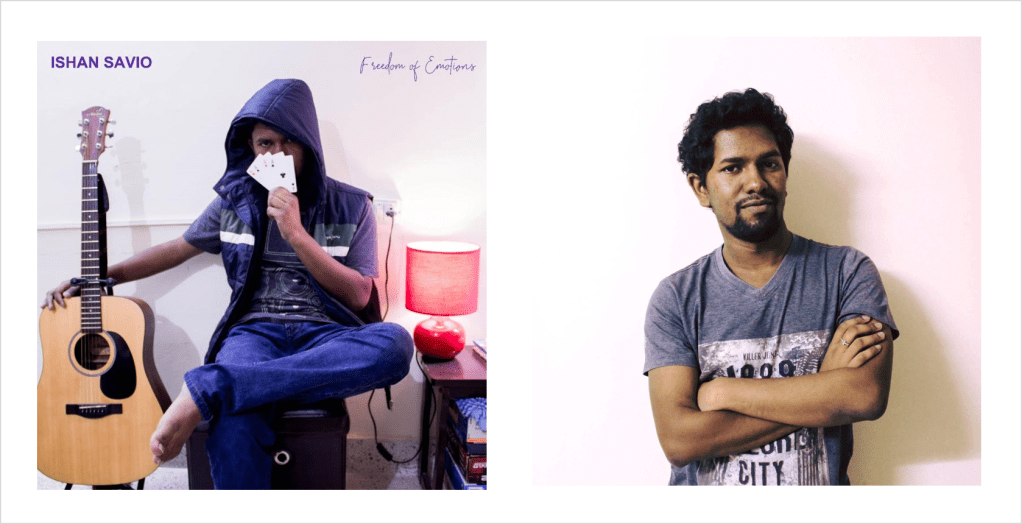
Album art (Left) and Artist Profile photo (Right)
There was no revenue for eligible withdrawal, but it did help get my music across to listeners much easier. The same year I also decided to get a personal keyboard for stress-busting, practicing music, learning keyboards, and improving my musicianship as a hobby.
Through this experience that started as a small project back by passion for a hobby, I learnt about one of the processes of getting your music out there and perform for music lovers. I learnt about branding, marketing, promotions, tax on intellectual property, international laws, socializing and communicating. I also learnt a bit of management, without a book. I learnt how to create an impact, remembering for whom musicians are really sing, playing and writing songs for – the people. I made many musician friends. We shared tracks, discussed music, supported each other, attended each other’s’ performances or concerts and sometimes even jammed or performed together.
Music is an expression. It relieves and entertains. It is created and even inspires creation.











 Ishan Savio