Since a couple of weeks, I had been getting suspicious posts from my friend’s social media account. I knew that her account had been hacked. The fraudster was using her identity and her account to convince people that she was winning lotteries and giveaway money and dupe their targets of money and also taking control of their social media handles. Today, the fraudster tried to make me their target.
They sent me the infamous “Guess the number and win” 40K photo. (Money giveaway fraud)
So I decided to play along. I guessed the number and asked the person on the other side to pay up. The fraudster congratulated me and said that I had won giveway money and asked me how I wanted to intiate the transfer. I told them that they could transfer via UPI. The fraudster ask me to do something first, which was quite expected. They asked me to change the email address associated with the social media account. For those who don’t know, doing this can give complete ownership of your social media account to the unethical hacker/fraudster. They asked me to do it and share a screenshot.
So, of course I didn’t do it. But, I did share a fake screenshot using simple free pre-installed tools on a computer/laptop. The conversation went like so, although the hacker deleted many of their messages once the conversation was over.
They had also provided me fake screenshot messages showing that people had received the money, which they deleted. It was time to end the conversation.
The hacker has committed identity theft and financial fraud and probably continues to do so. I knew they wouldn’t pay by regular channels because if they did, it would disclose information about the hacker. I confirmed with my friend over the phone if her account was really hacked over the phone and reported the account. Later, the hacker blocked me.
Anyone can be a victim of Cyberfraud, no matter the education. Even doctors and layers have been victims of cyberfraud. Here are a few things you can do to keep yourself and your friends safe:
Stay alert.
Change passwords regularly and keep them strong.
Read/Watch updates on cybersecurity from time to time, to know about the new methods the fraudsters use.
If it is an email, always check the email address.
Do not click on any suspicious links or pop-ups on emails or the web.
Always use Two-Factor aunthentication for your accounts.
Never share OTP or PIN numbers.
Help a friend out. Report accounts that are hacked and do so in large numbers with attachements/screenshots if you have any.
Reach out to the Support team of the social media app or website.
File a report to the Cybercrime Cell of your country.
I had been learning and playing the guitar since early 2005 at a comfortable age of 12. I’ve had three music instructors for guitar and music theory. I appeared for few guitar and music theory certifications as well, by Trinity Guild Hall (London) and joined an intermediate course much later by Nathaniel School of Music (Bangalore).
Although I picked up an instrument to learn at that age, I had been into singing earlier and even had an opportunity to get some basic vocal training in Hindustani Classical music. When I was in high school in 10th standard, I started writing songs and composed an instrumental track in 2009. I discussed it with a friend and we improved on it and another friend even added lyrics to it, but it never got materialised.
After my senior secondary (12th standard/PUC) exams, we got a 3-month break. I took decided to spend that time write lyrics and composing. I wrote several songs and wanted to make an album. But I also wanted to put my best songs forward and since the ‘project’ was independent and entirely self-funded (or let’s say parent funded), I decided to make an EP (Extended Play) rather than an LP (Long Play). An EP has 4-6 tracks as opposed to 12-13 tracks in LPs. It is based on track duration and its origin goes back to vinyl records.
I had made a musician friend in the city who was also a guitar, a brilliant one at that. One day, as we were chatting over ‘Messenger’ (Facebook, now Meta) and I told him about my project. Incidentally, he was planning to start a home studio and take up clients. So, we had a discussion at his place and decided to recorded five of my tracks.
Glad I got to be one of his first clients, I starting recording my compositions one by one. I used a software to convert music notations into audio and sent it to him to give him an idea of what I had in mind. We recorded the instruments. He suggested that he’d play and asked me to focus on the vocals. He played the guitar and piano sections of my compositions and added synth and other effects wherever required. The drums were programmed using a MIDI board. I sang for my first track ‘For Nothing.’ This song took the longest time to compose and is also the longest track in the EP, ‘Freedom of Emotions,’ but took only one take. Although we did record it multiple times for panning, variations, and other track requirements.
After the first track, I recorded a song dedicated to two of my close classmates who had accidental deaths. The next song was the title track, ‘Freedom of Emotions.’ I decided to work on this song with my friend, guitarist, and producer together. I had composed it with all the sections, melody, scale, chord progression and time signature and written the lyrics. He added variations in the guitar harmonics intro using layers and improved the strumming pattern and added a kickass guitar solo. The song had less lyrics and progressed quickly, so I gave him complete liberty with the section before the outro and the results were epic! Next, there was a track called ‘Break Free’ that his father really liked. Finally, we ended the EP with the only Hindi track in the EP, ‘Itni Sundar Tum Ho Kaise,’ which has the highest hits in the EP, followed by the title track. Like so, after mixing and mastering, in 2012 in the city of Guwahati, my music album was ready. The music in the tracks were played, mixed and mastered by Siddhant Das from Studio Dreamcather, Guwahati, which now stands closed.
Now as I was an 18-year-old with an independent music project in 2012, I didn’t want to go to any marketing agency. So, I decided to do it on my own, with absolutely no experience of marketing and promotions. Maybe taking up Commerce for 10+2 studies helped.
There were was no Spotify in India back then and online music distribution platforms weren’t quite active. I uploaded my tracks to platforms like SoundCloud and ReverbNation for streaming initially and shared the links to Facebook. I created and managed a Facebook Page and a YouTube Channel. I added my music to more platforms like MuSlate and SongDew. I also shared links to the songs and sometimes the tracks themselves with friends. I also availed the tracks for free downloads for a limited period. The responses were positive.
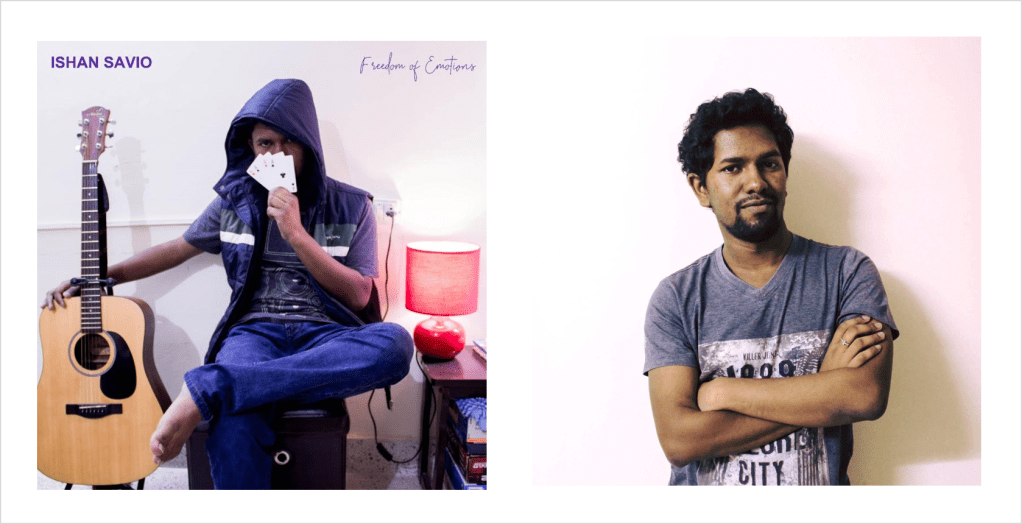
The album art that I used for ReverbNation was a simple a simple photograph from the balcony of an apartment flat that our family were living in as tenants in Uzan Bazar, Guwahati.
When I joined Undergrads that same year, I performed many times in college events and performed my tracks and newer compositions as well. During my PG studies, I was invited to take up independent sections of events for music. I also performed in open-mics in various locations in Bengaluru. I was also into photography. So, one evening when I was clicking photographs for a friend’s music gig, she asked me to perform 1 or 2 songs as well. The artist manager at the venue was really impressed by my performance and we got talking. He offered me a gig as well. But I unfortunately had to cancel it later, as I got busy with my dissertation at the University.
When Instagram launched and I started using an Android phone, instead of a Lumia phone, it was a great platform initially for sharing my photographs to it users Although Instagram has evolved to be a completely different platform today for creators, businesses, and all other users for various purposes. I also uploaded short video covers of popular songs on Instagram over time, performed some originals, used Instagram for promotions and even went live to perform.
I also wrote poems, articles and stories on WordPress. So I added a section to my music links there as well, for people to listen.
Much later, when Spotify was in India and other music streaming platforms like YouTube Music, Amazon Prime Music, JioSaavn were also getting popular, and I had some personal savings, I decided to distribute my music through online streaming platforms including Apple Music Store using cdBaby in 2020.
Album art (Left) and Artist Profile photo (Right)
There was no revenue for eligible withdrawal, but it did help get my music across to listeners much easier. The same year I also decided to get a personal keyboard for stress-busting, practicing music, learning keyboards, and improving my musicianship as a hobby.
Through this experience that started as a small project back by passion for a hobby, I learnt about one of the processes of getting your music out there and perform for music lovers. I learnt about branding, marketing, promotions, tax on intellectual property, international laws, socializing and communicating. I also learnt a bit of management, without a book. I learnt how to create an impact, remembering for whom musicians are really sing, playing and writing songs for – the people. I made many musician friends. We shared tracks, discussed music, supported each other, attended each other’s’ performances or concerts and sometimes even jammed or performed together.
Music is an expression. It relieves and entertains. It is created and even inspires creation.
This is a question the young ‘eligible’ unmarried adults get asked once they cross a ‘certain’ age (at least in India). This question has been around for generations and never seems to get old. Most times they’re awkward, maybe sometimes they leave the young adults in abashment. Although they could often be annoying, with an evident unsolicited match-making intent.
Although the definition of marriage has remained the same, its meaning over time has changed. In the Indian context for example, categorizing marriages are ‘love marriage’ or ‘arranged marriage’ seems like a narrow perception if we go by the definition and history of love marriages and arranged marriages in India. An arranged marriage follows a process of marriage where there is match-matching by relatives, friends, acquaintances of the parents of the groom/bride, matrimonial guides, sites or priests. After the bride and groom meet, there is a courtship period. In the case of Hindus, horoscopes (and caste) are matched and considered crucial. Love marriages are ones where two consenting adults fall in ‘love’ and decide to get married.
Although the concept of a ‘love’ marriage seems pretty straight-forward, historically it was looked down upon in India and in some cases not allowed by the family and even considered dishonourable. This still exists in some regions of India. Eloping became common in love marriages at a point of time.
But what is marriage without love? Yes, one can fall with their spouse after marriage. Yes, couple united by ‘love marriages’ get separated too. The reverse is true as well, where love marriages last forever and arranged marriages break, even if they don’t on paper. Divorces weren’t prevalent in India. A marriage was considered sacred and still is. Divorces have been rising lately though, not because it is a legal agreement. But because of various genuine reasons as well.
Returning to the question of “When are you getting married,” there are many underlying aspects related to the decision behind this response, if one chooses to respond honestly that is. The most common honest response could be, “I don’t know” or “I’m not sure.” Marriage is a union. Yes, it is a union of two families. But most importantly it is the union of two individual souls who decide to become one, through constant companionship, surrendering and love. It is a promise of mutual strengthing and support.
So each person needs time and space to introspect on the aspects related to the decision of marriage. Personal mental and financial confidance is extremely relevant before saying “I do” for another. One’s career and one’s understanding should align and/or compliment with the future spouse’s ambitions for a sucessful marriage. Most importantly, one must be able and willing to submit themselves completely to the union of marriage through independently conscious, mutual consent.
Today, young adults including myself, are faced with a plethora of realities, experiences (probably not long, but profound) and global cultures and tradition. The meaning of ‘love’ too keeps getting redefined, learned, unlearned an re-learned. There are women whom men are attracted to but have no emotion for. There is also the case where they love a woman like no one else and maybe even find attractive but not in a sexual way. There could also be women who give their heart and soul to a person they believe is their soulmate. But then again, broken hearts of women could sometimes even be blinded by the wounds of past hurt that they can even believe that a virtuous man is in fact approaching them only to take advantage of them. It isn’t the fault of anyone. We can’t read minds, can we?
They say marriages are made in heaven, but there are everyday humans who aren’t legally allowed to get married in some countries despite living a life filled with love and companionship despite countless hardships. #pride
Now when I think about the quesion of “When are you getting married?” … I think, are they ready for the response? Can they understand the underlying realities associated with that question? In a world of changing realities, uncertain economies and information explosions that affect and form our minds; in a time of growing anxieties from tasks that shouldn’t naturally cause such, it is not always a simple answer. It sure is never easy. To understand the language of the heart, ones needs to listen to the heart amidst the noise of the new conditions of life we live in.
Q: “When are you getting married?” A: Fate will lead me to mutual love. Mutual love will lead me to marriage. All else will abide by this fate.




 Ishan Savio